I almost gave up on AI video after my third render.
Not because the model was bad. Because I had no idea what I was doing wrong. Same idea, same effort, three completely different videos. And the moment I finally got a shot I liked and tried to film the “next scene,” my character didn't even look like the same person anymore.
That frustration is where Chaircut started — as a learning project that got out of hand, in the best way.
The problem nobody tells you about
Prompting a video model is nothing like prompting a chatbot. Veo, Sora, Kling, Hailuo, Wan, Seedance — each one expects a completely different structure. A prompt that produces something beautiful on one engine produces noise on another.
And if you create in Arabic, it gets worse. Most tools quietly translate your idea into generic formal Arabic — or straight into English — before the model ever sees it. Your dialect, your voice, your way of saying things: gone.
Consistency and creativity were fighting each other, and no amount of clever prompting was going to fix that.
Some tools solve this with templates — pick a preset flow, follow the format, get a predictable result. That works. But you're borrowing someone else's creative decisions to get there. I wanted something that understands my idea instead of asking me to fit it into a box.
So I built a director, not a text box
Chaircut sits between your idea and the video engine, and works the way a real director works:
- It listens first. It reads your words and your reference images, detects your language and your exact dialect, and maps what's missing from the idea before anything else happens.
- It plans like a producer. Instead of running everything every time, it assembles only the specialist crew your idea actually needs — story, cinematography, feasibility, continuity.
- It writes in the engine's native language. One idea, compiled properly for whichever of the six engines you're rendering on.
- It criticizes its own work. A strict in-house critic scores every draft across several quality dimensions and sends it back for revision until it's genuinely good. No rubber stamps.
- It protects your budget. A safety gate flags risky or wasteful renders before your credits are spent — not after.
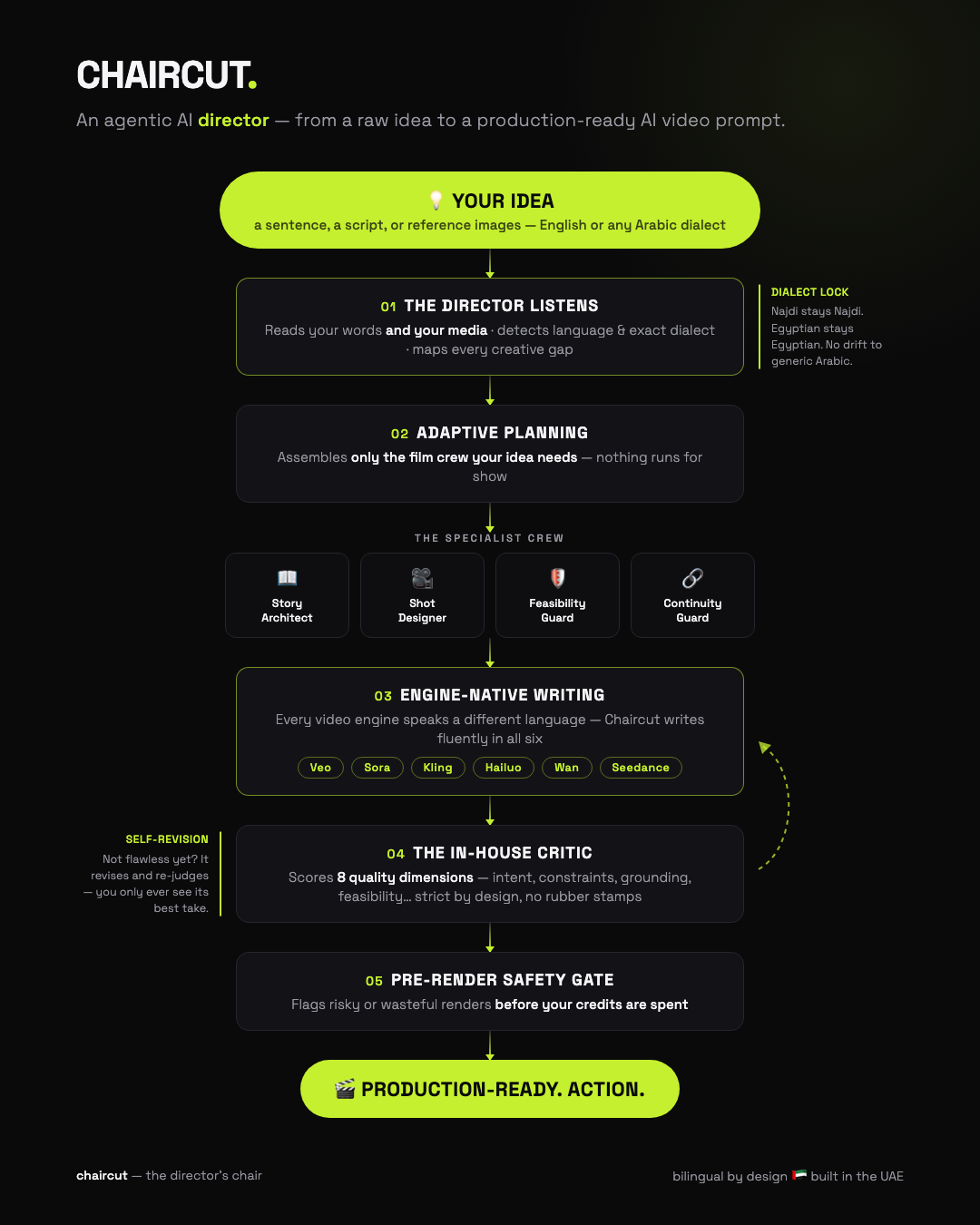
Chaircut detects the specific dialect you write in — Najdi, Egyptian, Levantine, Khaleeji — and locks it. Your dialogue and on-screen text stay in your voice, never flattened into generic formal Arabic. Najdi stays Najdi. Egyptian stays Egyptian.
فكرتك، بلهجتك، بصوتك.Which engines does it direct?
One idea, six engines. Chaircut compiles your brief into each engine's native prompt grammar:
| Engine | Provider | Tier |
|---|---|---|
| Veo 3.1 | Flagship | |
| Sora 2 | OpenAI | Flagship |
| Kling | Kling | Standard |
| Seedance | ByteDance | Standard |
| Wan | Alibaba | Standard |
| Hailuo | MiniMax | Budget |
A work in progress — on purpose
Chaircut is free and open for anyone to try. The video generation API is already wired up, and I'm still deciding on the business model — subscription credits, or bring-your-own-API-key. Honest answer: I'd rather hear what you'd prefer than guess.
There's more coming too. Plug-and-play integrations for other media types are on the list, and eventually a single flow where you create, upload, and schedule your videos without ever leaving the tool.
If there's a feature that would make this genuinely useful for you — tell me. That's the whole point of shipping it early.
Frequently asked questions
What is Chaircut?
Chaircut is the first Arabic-native AI video director. Drop in a rough idea — text in any Arabic dialect or English, an image, a voice note, or a PDF — and get back a production-ready cinematic prompt for Veo, Sora, Kling, Hailuo, Wan, or Seedance.
How is Chaircut different from prompting Veo or Sora directly?
Each engine expects a different prompt structure. Chaircut compiles one idea into each engine's native grammar, detects what's missing from your brief, scores every draft with an in-house critic, and gates risky renders before your credits are spent.
Does Chaircut preserve my Arabic dialect?
Yes. Chaircut detects your specific dialect — Najdi, Egyptian, Levantine, Khaleeji, and others — and locks it, so dialogue and on-screen text stay in your voice instead of being flattened into formal Arabic.
How do I keep the same character across scenes?
Chaircut's World Bible (Cast & Locations) stores character descriptions, wardrobe, locations, and lighting setups, then injects them into every prompt automatically so faces and places stay consistent across takes.
Which AI video engines does Chaircut support?
Six engines across budget, standard, premium, and flagship tiers: Google Veo 3.1, OpenAI Sora 2, Kling, ByteDance Seedance, Alibaba Wan, and MiniMax Hailuo.
Is Chaircut free?
Yes, Chaircut is free to try. Building prompts is free; rendering finished video uses credits under a subscription model that is still being finalized.